Showing posts with label teaching ideas. Show all posts

Wednesday, December 11, 2013

It's Snowing Symmetry!

There's no snow here in central Florida, but that doesn't mean I can't draw a flurry of line symmetry designs, right?
Snowy Symmetry has designs for Winter and Christmas such as a penguin juggling snowballs, silly snowflake and star characters, a walrus, a teddy bear, a gingerbread boy, girl, and house, and Santa holding a gift. There are 16 designs with 3 levels of difficulty, making 48 designs in all.
Teachers have left enthusiastic feedback on my fall and spring symmetry packets such as
Great symmetry lessons that scaffold for younger students.
My kids love these and the differentiated variety meets everyone's needs!
Loved this activity. The kids wanted to do it all afternoon

If you would like to combine math and art in a seasonal project, please check out Snowy Symmetry. There is a FREE sample to try in the Preview.
Click cover to view Snowy Symmetry!
Another chilly option is one of the first classroom resources I made, Ready, Set, Snow! Printable Snowflakes to Match Pairs and Halves:
Click cover to view Ready, Set, Snow!
I wish you a very happy holiday season!

Loreen
My web site

Thursday, September 19, 2013

Information Options: Presenting Nonfiction Topics in Picture Books

Today I'm delighted to be presenting a keynote address for the Utah Valley University Forum on Engaged Reading. This post has my notes as well as links referenced in Information Options: A variety of ways to present nonfiction topics in picture books. The links for my breakout sessions are included also.

NOTES
How do people get information? How do children get information?

From prehistoric times, humans have observed the world around them, and wanted to tell somebody about it.

Kids are told many things by adults including parents, relatives, neighbors, and teachers. Children also find things out by first-hand experience, by doing things.

Long distance and mass communication: Town crier, carrier pigeon, letters, (now emails or texts,) newspapers, magazines, radio, telephones, TV, movies. Then computers, Internet, smart phones, search engines

Today's focus: The kind of information children can find in picture books and the multiple ways it can be presented.

What can nonfiction books look like? The bad old days of long paragraphs of text with a few rectangular photos...are they really gone?

Some general categories of nonfiction books:
Just facts
Information + Context to make it more meaningful
Information + Process: how X is built
Information + Activity: make a craft, do a science experiment
Information + Argument: why X is good or bad

Solving for X: key elements to consider when creating an informational picture book
Main Idea; Facts; Age level; Title; Setting; Characters; Plot or Sequence; Writing options; Image options

Some of the combinations found in my books (links go to the book's page on my web site):
Symmetry + Many Examples + Line & Rotational symmetry + realistic images = Seeing Symmetry
Sequence: “What is symmetry?”...starts with Line then Rotational


Mars + Photographs + Kids + Writing = Messages From Mars
Plot: group of kids that win a trip to Mars, write home about what they learn

Animal sayings + Meanings + Comical animals + Antique art = There’s a Frog in My Throat
The groupings are based on where animals live, e.g. On the Farm; In the Wild

Similes + Story + Comical Animals + Transformations = Crazy Like a Fox: A Simile Story
Plot: Fox acts “crazy,” provokes sheep to follow him, leads her to surprise party

Prehistoric + Chronological + Realistic art + Playful = My Teacher Is a Dinosaur and Other Prehistoric Poems, Jokes, Riddles, & Amazing Facts
Chronological overview, realistic artwork, playful presentation

Math + Delete Numbers + Problems + Fantasy = Missing Math: A Number Mystery
A way to show the value of math by removing it, detective story

Energy + Types + Step-by-step + Characters = The Shocking Truth about Energy
Major types, Steps of energy production, characters come to life with energy

MyPlate + Big food images + Read aloud + Fairy tale = Jack & the Hungry Giant
Large images of food, story for context, Jack & the Beanstalk

Diverse ways of presenting information in books is important, because READERS are diverse.

ALL LINKS

All Loreen Leedy picture books are on this page of my website. There are links to individual book pages that have a summary, the ISBN numbers, activity ideas, trailers, and more.

This is a blog post with ideas for introducing Seeing Symmetry including using hands-on foldables and the words to a symmetry chant.

I've made several free activities for my books including the ones shown below:
Click image to go to activities download page on TpT
Click image to download
Download my free book activities in my Teachers Pay Teachers shop. More are under construction and will be in my shop as they are created. Be sure to "follow me" to be notified.

Other activities are downloadable from this page of my web site.

The Nonfiction Reading Response Cards shown on the left will be free during the conference.

My Pinterest boards are mostly full of teaching ideas on various topics such as Making Math Fun, Kids + Nonfiction, and Eating My Plate. Click to view them all and follow the ones that interest you. A collaborative board I contribute to called Learn to Read has over half a million followers!

ClipArt Etc. has thousands of antique images that are free for educators to use in the classroom. Additional images can be found on a sister site, Presentations Etc.

Holiday House Books for Young People has a page of books categorized by themes such as character education, cultural diversity, math, science and nature, and many more. They also have Teachers guides, Activity pages, and other freebies on this page. Here are all my Holiday House books that are in print.

Life Changing Nonfiction Series: during the month of September, I.N.K. bloggers are writing about nonfiction books that inspired them as children and comparable books that are available today: I.N.K. (Interesting Nonfiction for Kids)

Nonfiction Monday is a weekly roundup of blog posts about nonfiction books. It's hosted on a different blog every week, so check the schedule here.

Here is a free template for kids to make a map of their bedrooms using Mapping Penny's World as a mentor text on the School is a Happy Place blog.

See a class writing their own simile story using Crazy Like a Fox as a mentor text on the 4th Grade Frolics blog.

Why should kids read nonfiction?
Beyond Once Upon a Time by Nell K Duke.

Whew...hope this post is useful...if so, please leave a comment!

Loreen
My web site


Thursday, August 22, 2013

Label a Sea Turtle, Woolly Mammoth, or Allosaurus!

An example of one of the Common Core State Standards that pertains to learning vocabulary is CCSS.ELA-Literacy.RI.2.4: Determine the meaning of words and phrases in a text... Labeling a diagram requires linking the word with an image, which activates multiple pathways in the brain—always a good thing!

Another relevant standard is CCSS.ELA-Literacy.RI.2.7: Explain how specific images (e.g., a diagram showing how a machine works) contribute to and clarify a text.

I've created three printable labeling activities so far. As shown below, the artwork for these activities is realistic which I think is important for this kind of nonfiction material. Cute images are fun but can be misleading in a science education context.

Sea turtles are one of my favorite animals—it's truly amazing that these reptiles have been around for millions of years. The Label a Sea Turtle! diagram includes the vocabulary words head, eye, nose, beak, neck, flipper, shell, scute, tail, and scale. A second diagram of the sea turtle life cycle is also included with the words eggs, hatchling, beach, nest, female, tracks, adult, ocean, juvenile.
Click cover to download the preview in my TPT shop

Answer keys are included, naturally. It's perfect for Ocean, Marine Animal, and Reptile units. The species of sea turtle is the loggerhead, by the way.

The Woolly Mammoth is another wonderful creature that is included in Ice Age and Prehistoric units as well as ancient North American history. Label a Woolly Mammoth! has the words hair, eye, foot, leg, tail, tusk, trunk, ear, back, and head.
Diagram to label a woolly mammoth, CCSS.ELA-Literacy.RI.2.7
Click to find in my TPT shop

Last, but definitely not least is a fearsome meat-eating dinosaur diagram. Label an Allosaurus! can be used with Dinosaur, Prehistoric, or Predator units, and includes the words arm, back, claw, eye, head, leg, neck, tail, teeth, and toe.
Diagram of an allosaurus dinosaur to label. CCSS.ELA-Literacy.RI.2.7
Click to go to my TpT shop
I hope these activities will be useful to help kids learn about animals past and present.

If you're interested in an entertaining book about prehistoric life, please take a look at My Teacher Is a Dinosaur and Other Prehistoric Poems, Jokes, Riddles, & Amazing Facts. The School Library Journal review says: ...the tantalizing facts and pictures in this book will stimulate readers' curiosity.

These FREE activities to go with the book are in my TpT shop at this link.
Thanks for stopping by!

Loreen
My Web Site

Friday, August 16, 2013

New Classroom Resources + Freebies!

While on a trip recently, I doodled this idea for a poster activity:
The purpose is to help kids focus on descriptive sensory language in what they are reading. When they find an example of a sight, sound, taste, smell, or touch-related detail, they will record it in the corresponding area of their poster.

The poster can be used with any text of reasonable length such as a magazine article as well as fiction or informational books. Here is a sample of the poster already filled in:
As they read, students will record words or phrases that relate to the 5 senses— rough fence; everyone stares; flavor of grass; sniffs the air; listens for the cow bell— or write a short summary as shown above to give more context.

There's also a vertical version included which you can see in the lower right of the cover:
Click to see 5 Senses Read & Write in my TpT shop.

Another new item is this Owl Combo Pack of Whooo's In Our Class? get-to-know-you foldable plus Owls Are All Write! Graphic Organizers and Writing Papers.
Though this is discounted already, it will be included in the sale. The same goes for the Similes Classroom Books Combo Pack:
Similes & Meanings has 30 familiar similes for kids to illustrate, while Simile Starters has 30 prompts for students to write new, original similes.

We're Nuts About Goals! is a fun craftivity for kiddos to learn about setting goals as early as Kindergarten. They don't even have to be able to write, they can just draw pictures on the acorns. Learning how to set and achieve goals can make all the difference in life so it's an important concept for all students.
Age-appropriate goals could include:
Learning a specific new skill
Meeting a particular Common Core State Standard
Following a class rule
Improving a certain behavior
Trying new things
Reading X number of books
Practicing something a certain length of time per/day or week

As always, my classroom resources including the graphics are original creations by me. Speaking of graphics, this Apple Frames FREEBIE has gotten a ton of downloads and great feedback already:
To make it easier for teachers to find my freebies, there is now a Freebie Category in my shop. To find the newest resources, click on the Most Recent link on the main store page or the NEW! category.

These are most of the "newbie" resources in my shop. I love making classroom resources so more are on the way!

Loreen
My web site

Tuesday, July 30, 2013

Making Math Fun!

In my junior high school days a guidance counselor had to listen to this confident declaration: "I'll never pursue any career that has to do with math!" Naturally I ended up being a bookkeeper for my freelance business, measuring pages, illustrations, and/or type on a daily basis, and have created over a dozen math picture books so far. It wasn't a very good estimate of my future activities, was it?

One of my primary goals has been to present the side of math to kids that is intriguing, entertaining, light-hearted...in other words, fun! In that spirit, here is a screenshot of my Making Math Fun! board on Pinterest:
This board has over 300 pins with all sorts of ideas for teaching elementary level math from place value to money to basic facts to graphing. I follow over 5,000 people/boards on Pinterest, so great ideas are added on a regular basis. 

If you'll be implementing Common Core this year, over fifty pages of teaching tips and links to freebies can be found in this FREE Common Core Math Back-to-School eBook for Grades 3-5, from a group of teacher-authors on TeachersPayTeachers. (There are similar ebooks for other grade levels and ELA topics.) Here are some pages, just to give you an idea:
The Math Content standards are cited to make it easier for teachers to find what they need. Here is a close up of my page (22), which focuses on line symmetry in Grade 4 Geometry, CCSS.Math.Content.4.G.A.3:
One of my Pinterest boards is devoted to symmetry and has hundreds of pins, if you need any more inspiration on that subject. Collecting ideas and images on a topic is a little obsession of mine which makes Pinterest my favorite place to do research on almost anything.

I hope you have plenty of fun with math in your future!

Loreen
My web site

Monday, July 15, 2013

Falling for Symmetry...Autumn Pictures to Draw and Color!

Ever since working on my picture book Seeing Symmetry, I've had an ongoing obsession with symmetry. My Pinterest board with teaching ideas on the subject has over 1,500 followers, so at least I'm not the only one! Because my Spring/Easter egg activity has been so popular, it seemed like a good idea to make a similar one for fall. It's called Falling for Symmetry: Math + Art for Autumn, Halloween, & Thanksgiving. The feedback has indicated that teachers and students LOVE to be able to combine a math lesson with an art activity.

As the image below shows, there are 3 levels included: Color only; Trace dashed lines; Draw the missing half. It's easy to choose the right one for students with different abilities.
Two of my lovely nieces were able to help "demo" Falling for Symmetry, using the most advanced version. Kids can draw the missing half by eye (scarecrow) or can use a ruler to measure and mark key points first (owl.) One of the girls measured the width of the owl's head, chest, leg, and so on.
Using the ruler definitely made it easier for her to draw the 2 halves as matching mirror images.
After the lines were drawn, she went over the lines with a black marker. Next the owl was partly colored in ...symmetrically, of course.
And here is the scarecrow in progress. I asked the girls what their favorite coloring tool is...markers, colored pencils, crayons? They like using crayons the best because they don't bleed like markers and give a more vibrant result than colored pencils.
Here are all of the pictures the girls completed. One of the fun aspects about these symmetry pictures is that each student chooses their own colors so they all turn out differently.
The packet has 20 images in all: 10 general autumn, 6 Halloween, and 4 for Thanksgiving. To download the Preview with more info and a free sample page to try from my TPT shop, click here or on the cover image below.
Click to visit my TPT shop
The Common Core State Standards include line symmetry in 4th Grade geometry (4.G.3) but the underlying concepts of equality (matching), halves versus wholes, unit fractions, and so on appear in earlier grades. Thanks for reading!

Loreen
My web site
Click link below to check out my newest picture book on Amazon:
Jack and the Hungry Giant Eat Right With MyPlate

Friday, July 5, 2013

They're here...Jack & the Hungry Giant Eat Right with MyPlate!

I was rummaging around on Amazon today, and noticed that my new picture book is shipping as of July 1st, so woo hoo! I've only gotten one advance copy thus far, guess the rest of my copies must be on the way. Jack & the Hungry Giant starts out like the traditional fairy tale...Jack gets the beans, they're tossed in the garden, he climbs up the resulting beanstalk and enters the giant's castle. Right away, he runs into a little glitch, or rather, a big furry one!
There may not be a kitty in the original tale, but this orange one demanded to be put into the story. Jack is chased inside a smelly boot, then discovered when the giant arrives home. The giant declares, "I'm hungry!" so the terrified boy makes a dive for it. The giant grabs him by a shoelace, tells him to be careful, and offers to cook him a healthy meal. Waldorf, as it turns out, is a friendly giant and also a wonderful chef.
As they prepare the meal, each spread shows colorful illustrations of the wide variety of foods in the Fruits, Vegetables, Grains, Protein Foods, and Dairy groups. They dish up their plates and enjoy a delicious meal together, along with Waldorf's wife, Zofia. At the end of the book, Waldorf's Tips for Healthy Eating summarizes the MyPlate program and shows many of the foods with empty calories. The last page includes the exercise activities they enjoy in addition to climbing up and down beanstalks.
To look at the book on Amazon, click on this link: Jack and the Hungry Giant Eat Right With MyPlate

Update: During the month of October, the publisher is sponsoring a #giveaway of several copies on Goodreads.

I've posted a FREE activity to go with the book in my TeachersPayTeachers shop. To complete I Can Fill Up My Plate! students will finish writing prompts, make a list of foods in the various groups, then fill up their plate with drawings or cut out photos. Click here to go to my TPT shop and download this resource.
Click cover image to visit my TPT shop
There aren't very many kid-friendly resources to introduce the MyPlate nutrition program, so I hope these will be useful.

Click to visit the Kit Lit blog hop, which has links to over 50 posts about children's books!

Loreen
My web site

Wednesday, June 26, 2013

A Different Kind of Mystery Picture [Part 2]

Part One of this article is here.

The next puzzle is going to be based on one of my favorite math concepts, symmetry. If you're a new reader of this blog, my most recent picture book is called Seeing Symmetry (see a video preview here.) Anyway, I wanted to use shapes with and without line symmetry for the clues. The kids find the symmetrical shapes to solve each clue. The squares (on the left) have the lines that will be drawn in the grid square.
The photo below shows the clues page with some of the symmetrical shapes circled in orange. The grid rows and columns are indicated by different symmetrical shapes. By the way, line symmetry is introduced in grade 4 of the Common Core State Standards (4.G.3), and it's also taught in 3rd grade in many states. Just a few of the squares have been drawn in so far (see below).
 Once all the clues have been solved and the lines drawn in, an owl with outstretched wings should appear.
As you can see, the owl is also symmetrical. Any glitches in the drawing will be obvious and the student can double-check that square again. Once it looks correct, they go over the lines with a black or dark marker. I like the Crayola® brand  SuperTips because they are a good thickness, are washable, and don't have that awful brain-melting smell that certain markers do (yes, Sharpie, I'm talking about you.)
One of the nice aspects of this different kind of mystery picture is that once the drawing is complete, each kiddo can color it with their choice of colors.
It'll be fun to see the whole flock of uniquely colored, symmetrical owls that will fly in, don't you think? Here is the cover and a link to this puzzle:
Click Cover image to visit my TPT shop
Thanks for reading, and let me know if you like this kind of mystery picture…I'm interested in any and all opinions pro or con. Toodleloo!

Loreen
My web site


Sunday, June 2, 2013

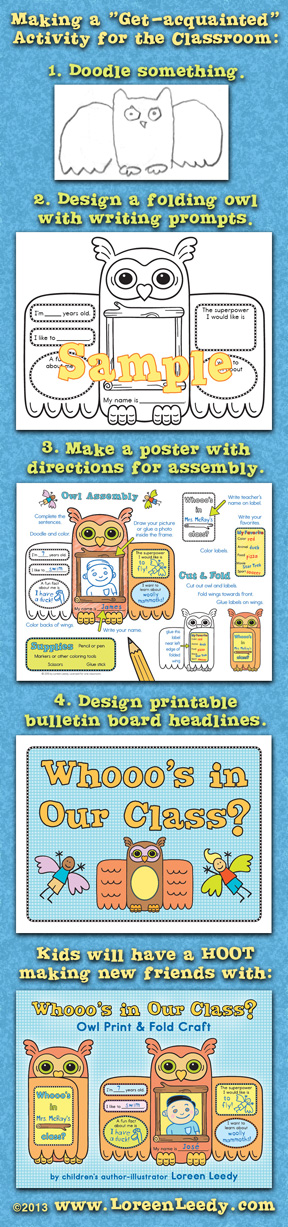
Whooo Likes Owls? From Doodle to Designs

Recently I was doodling some ideas for fall writing templates. (Yes, I know the school year is barely over and summer beckons!) This little owl popped up on the page.
There was something intriguing about him. Eventually, it occurred to me that with the out-stretched wings he could make an interesting 3-section graphic organizer. And as an option, the wings could fold in to hide the contents!
Naturally I went bonkers and made a bunch of them. There's a a KWL chart; Sequencing 1-2-3; Beginning-Middle-End; Are-Have-Can; and a Blank Template. They have primary lines, plain lines, or no lines, for 18 designs in all. They can be used for a wide variety of creative projects such as fall and winter writing, fiction and nonfiction about owls, forest animals, predators, food chains, and so on. Here is the cover of Owls Are All Write!:
Click image to visit my TPT store
After that was finished, I took my almost-90-year-old mother to visit family and old friends in the northeast. While we were on the road, another idea popped up, this time for a "getting to know you" activity. The long image below gives an idea of what Whooo's in Our Class? is all about:
Kids finish the writing prompts, doodle and color, draw or paste in a photo of themselves, and cut out and fold their owl's wings. Students can browse the finished owls to find out fun facts about each other. It will be great for a back-to-school activity or any occasion when kids are getting to know each other. It's a quick print and go kind of thing, which can certainly help in the hectic beginning days of school. This is my newest classroom resource, and will be discounted for a few days. I mark down all new products as a "thank you" to the wonderful teachers who follow me.

But for now, grab a book, relax in a hammock for awhile, and have a great summer! If your school year isn't over yet, hang in there!

Tuesday, April 9, 2013

Make a Class Book of Similes!

Similes are a type of figurative language, a subset of metaphors to be precise. In other words, all similes are metaphors, but not all metaphors are similes. Many familiar similes have been overused to the point they are considered clichés. We've all heard and/or said, "...as hungry as a bear," for example. But if you're a kid you don't know many familiar sayings. It's kind of a cliché Catch-22...you have to learn them to avoid using them! To help with this conundrum, I've already created a picture book written entirely with similes, plus a free follow-up book extension with real photographs of the items used in the comparisons (see this post for more info).

I just finished a set of 30 printable pages to help children learn similes by drawing pictures of them. First they draw a silly, literal picture, then a picture of the actual meaning. (Or at least, one meaning...many sayings have more than one meaning.) This image shows the steps leading up to a class book.
Click on image to visit my TPT shop.
As the last step shows, kids can use the Blank Template to write and illustrate new, original similes to add to the class book. Or the pages could be used in a bulletin board display of Familiar vs. Original Similes, as one idea. To download the Preview and try a sample page, please visit my shop on TeachersPayTeachers. Also included in the packet is the class book cover in color and black & white.

One group that has trouble with similes and other expressions are students learning English as a second language (ESL, ELL.) I can't imagine trying to make heads or tails of all the idioms we use at the drop of a hat. See what I mean? This activity was a lot of fun to create, and I hope people find it useful. Thanks for reading!

Sunday, February 17, 2013

St. Patrick's Day Freebie: A Comic Strip Template

My Comic Strip Templates for K–12 Writing have been popular so I was inspired to add a couple more. This one is for St. Patrick's Day, shown here with tips about using it:
Click image to go to Preview download page
To get a free sample of the 4-leaf clover template, go to this page in my TeachersPayTeachers shop and download the Preview. 

If you print it on green paper, it will look like this:

If you already have the Comic Strip Templates PDF, be sure to download the file again to get the new templates. 

For a linky party of March-themed teaching resources, please visit The Balanced Classroom.
Related Posts Plugin for WordPress, Blogger...
Pin It button on image hover